
In a wooden house in Khoma, a village tucked into the mountains of eastern Bhutan, a woman sits cross-legged on the floor with one end of her loom strapped around her waist and the other anchored to a post. She has been weaving the same length of silk for four months. When she finishes, somewhere around month ten, it will become a kishuthara, the most prized kira a Bhutanese woman can own. It will likely be worn at her daughter’s wedding decades from now.
This is what people mean when they say weaving in Bhutan is more than craft. The cloth carries time inside it.
Cloth that holds the country together
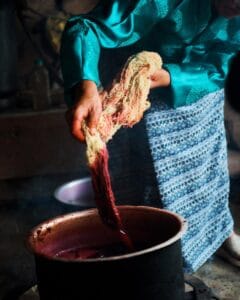
Bhutanese textiles are among the most intricate and technically demanding in the Himalayas. They are also among the most visible. Walk through any Bhutanese town and the country’s textile tradition is on every street: men in gho, women in kira, monks in maroon robes, schoolchildren in uniform versions of the national dress. Bhutan is one of the very few places on earth where traditional clothing is still the working wardrobe of an entire country.
For centuries, weaving has been the work of women. The skill passes from mother to daughter, sometimes grandmother to granddaughter, in long quiet apprenticeships at the loom. In many homes, especially in the east, the family loom is set up beside the kitchen, and weaving happens in the gaps between everything else.
What each part of Bhutan is known for
Different valleys are known for different traditions.
Eastern Bhutan, especially Lhuentse, Mongar, and Trashigang, is the home of silk weaving. The kishuthara, woven on a backstrap loom with intricate supplementary weft patterns, is the most prestigious cloth in the country. Khoma village in Lhuentse is the recognized heart of this tradition. A single kishuthara can take six months to over a year to complete, and the most elaborate pieces can cost as much as a small car.
Central Bhutan, particularly Bumthang, is famous for its wool. The yathra, a thick striped fabric woven on a horizontal frame loom, is used for blankets, bags, and jackets. Adha mathra and adha rachu, the striped red textiles of Bumthang, are easy to spot once you know what you are looking at.
Western Bhutan tends toward cotton and the half-kira styles that are common for everyday wear.
Each region’s weave reflects what its hills produce. Silk in the warmer, lower valleys of the east. Wool from the sheep and yak of the high pastures in the center. The geography of the cloth is the geography of the country.
What the patterns mean
Bhutanese textiles are read as well as worn. Patterns are drawn from a deep vocabulary of motifs: lotuses, mountains, vajras, dragons, clouds, and Buddhist symbols, alongside older designs whose names have been carried down through generations of weavers. Some motifs belong to specific regions. Some are associated with particular ceremonies. Many of the most respected pieces use thrima, a continuous supplementary weft technique that builds a pattern thread by thread across the cloth.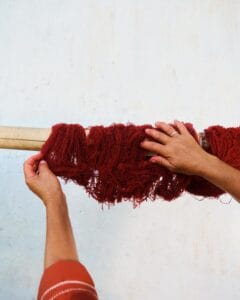
The colors carry meaning too. Traditional dyes come from madder, indigo, lac insect, walnut bark, and turmeric. Some weavers still rely on them entirely. Others blend natural and modern dyes depending on the piece.
The scarves that tell you who is who
Spend any time at a dzong or a formal event in Bhutan and you will notice the men wearing colored scarves draped diagonally across their gho. These are kabney, and the color is not personal taste. It tells you rank.
White is for ordinary citizens. Red is for senior officials and ministers. Saffron is reserved for the King and the Je Khenpo. There are several intermediate colors in between.
Women wear a corresponding scarf called a rachu, traditionally red and embroidered, draped over the left shoulder.
It is a small detail that quietly reveals how textile, hierarchy, and identity are stitched into each other here.
Where to see weaving as a visitor
Three places are especially worth your time if you want to understand Bhutanese textiles.
The Royal Textile Academy in Thimphu. The country’s main textile museum and a working institution. It houses some of the finest examples of Bhutanese weaving and offers context that brings the rest of the country into focus.
Khoma village in Lhuentse. A serious detour from the usual tourist route, but the most authentic place to see kishuthara being woven. Many of the weavers welcome small numbers of respectful visitors.
Local handicraft markets and weekend studios in Thimphu and Paro. Useful for seeing a range of styles and for supporting weavers directly. The Authentic Bhutan Handicraft Bazaar in Thimphu is a good place to start.
If you are buying, take your time. Ask where the cloth is from, who wove it, and what technique was used. A serious piece deserves serious attention, and most weavers and shopkeepers will happily explain the work in front of you.
Why a Bhutanese textile is more than a souvenir
A kira or a length of yathra is not a printed fabric run off a machine. It is a record of one woman’s months of patience, working on a single piece, often in a quiet corner of a small valley you have probably never been to. The pattern she chose came from her teacher, who learned it from someone before her.
When you bring a Bhutanese textile home, that is what travels with it. Not just thread and color, but a small piece of how this country has chosen, generation after generation, to spend its time.