
On a Sunday in any Bhutanese town, you can hear an archery match before you see it. The sounds carry. There is the slap of an arrow hitting a wooden target, followed almost immediately by singing. A small group of women, dressed in bright kira, are improvising verses about the archer who just shot, sometimes praising him, often teasing him about his stance, his strategy, or his marriage. The archer, holding a bamboo bow with another arrow already in his fingers, is laughing along with them.
This is the national game of Bhutan, and on paper it is archery. In practice it is something much wider. Part sport, part festival, part village reunion, part theater.
A target the size of a paperback, 145 meters away
The first thing to know about Bhutanese archery is the distance. The targets sit 145 meters apart, more than twice the Olympic range, and they are roughly the size of a paperback book. Hitting one is genuinely difficult, which is why every hit is celebrated as though it were the first of the day.
Two targets are used, one at each end of the field, and the teams shoot back and forth. After every successful shot, the archer’s teammates gather around him, sing a brief song in his honor, and slip a colored scarf into the back of his belt. By the end of a strong day, a senior archer can be wearing several.
Bamboo bows and compound bows
Traditional Bhutanese archery uses a bamboo bow called a dha, hand-made and surprisingly powerful in skilled hands. In recent decades, modern compound bows have entered the game and now dominate competitive play, especially at the national level. The shift has not been entirely uncontroversial. Older archers, many monks, and rural communities still prefer the traditional bow for its connection to lineage and to the slower craft of the sport. Visitors at a local match will often see both bows on the same field, with each team usually sticking to one style.
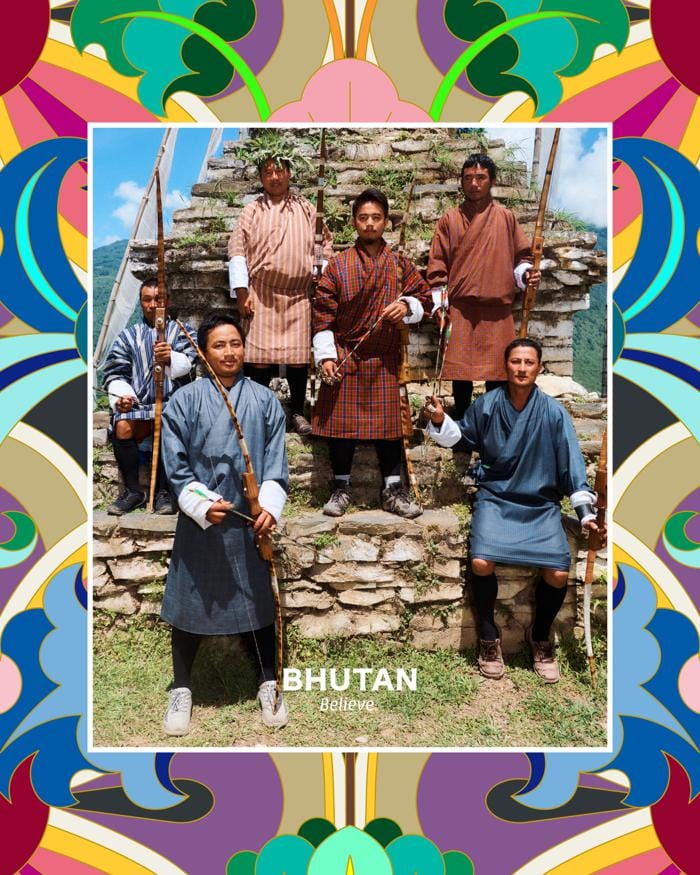
The role of song and teasing
The most distinctive thing about a Bhutanese archery match is everything that is not the shooting. Both teams have supporters, usually women, who line the edges of the range and sing almost continuously. Their job is partly to cheer their own side and partly to gently sabotage the other. The songs are improvised on the spot, full of double meanings, neighborhood gossip, and pointed jokes about whichever archer is currently taking aim. Skilled singers can rattle even seasoned shooters.
In return, the archers and their teammates respond with their own verses, often picking up a recent line and turning it back. Done well, it is closer to call-and-response poetry than heckling, and it draws as much of the crowd’s attention as the arrows themselves.
When a target is hit, the team runs out, links arms, and dances briefly in a circle near the target, singing the archer’s praises. The opposing team waits, sometimes good-naturedly, sometimes plotting their next verse.
A day-long social event
A match is rarely just a match. A serious tournament can run two or three days. Tea is poured. Ara and beer move quietly between rounds. Lunch tends to be substantial, often laid out by the host families, and old friends drift in and out of the field through the day. The archery ground remains one of the most reliable social spaces in a country where everyday life is changing fast.
It is part of why almost every Bhutanese town and village still has at least one public archery ground, and why so many families know exactly which weekend the next match will fall on. The arrows are not really the point. It is about who is on the field, who is at the edges, and who is missed when they do not come.
Other traditional games worth knowing
Archery dominates, but it is not the only Bhutanese game. A few others are worth noting if you happen across them on your travels.
Khuru. Often described as Bhutanese dart-throwing. Played with weighted wooden darts at distances of around twenty meters. Same social energy as archery, in smaller form.
Digor. A stone-throwing game that sits somewhere between shot put and boules, played on flat ground with carefully chosen stones.
Soksum. A short javelin throw using a wooden spear. Less common today but still seen at some local festivals.
Watching a match as a visitor
Tournaments around major holidays, like Coronation Day, National Day, and royal birthdays, are open events and easy to visit. Smaller weekend matches happen almost everywhere, and they are almost always welcoming to onlookers. A few practical notes if you go.
Stay well behind the archers. The 145-meter range can feel deceptive at first, and arrows do go wide.
Do not interrupt during a shot. The crowd noise is part of the game; sudden movement from a stranger is not.
If a team offers you tea or food, take it. You will probably end up watching far longer than you planned, and that is usually the point.
For all the changes Bhutan has lived through in the last few decades, the archery ground still feels like one of the places where the country quietly recognizes itself. The bow, the songs, the teasing, the slow Sunday afternoon. None of it is staged for visitors. It is simply how Bhutan plays.